Tampilkan postingan dengan label Modeling Tutorials. Tampilkan semua postingan

Magnetizing Bases

While working on my Space hulk Terminators, I'm magnetizing their feet so they can be placed on round bases for use in games of 40K. I touched on this briefly in my post about Brother Noctis, but I figured I'd show the process in more detail.


Since every model's feet are space differently, you'll need to make some adjustments when drilling the holes. Ideally, you want to have the magnets in the base set in two of the existing peg holes. If that's not possible, then use one of the holes and an open area. Check the fit on the bottom of the base to see which holes best match with the model's feet.


The rare earth magnets are 1/8-inch in diameter, so use a similarly sized drill bit to drill out the holes. Start by putting a hole in the model's foot and one in the base, through the peg hole.


To put the magnet into the model's foot, apply a dot of super glue to the top magnet in a stack. Press the magnet into the hole, leaving about 1/16 inch protruding.


Hold the magnet in place until the glue sets, then pull the rest of the magnet stack away. I find this method easier than trying to use tools or my fingers to hold the magnet; fingers are too fumbly and the magnet sticks to metal tools.


Drill out the other hole in the base.


To line up the spot to drill in the other foot, place the model on the base with its magnet in the first hole, and position the second foot over the other hole.


Then drill up into the foot through the bottom of the base. If it's difficult to hold the model steady, add a tiny dab of super glue to the feet. Use just enough to hold it in place and allow you to pop it apart when you are finished.


Now you have two perfectly positioned holes in the base and in the model's feet.


Glue the second magnet into the other foot. Then, add your basing material to the base, taking care to keep the holes clear.


To attach the magnets in the base, put them on the model's feet.


Then, stand the model on the base, with the magnets in the holes. Even with the thickness of the sand, the magnets will be at the proper depth to make contact with the model.  This method also ensures you won't accidentally glue them with the magnetic poles the wrong way around.


Add some super glue from underneath.


Then fill the holes with some ballast (sand) to give the magnets more surface area to adhere to and prevent them from sliding down.


Once the glue holds on the sand and magnets, pop the model free.


And there you have it– perfectly positioned magnets for interchangeable bases.


'Til next time!

Modeling Tutorial: Bow Strings

As you can see from the pictures, my skeleton archers are almost finished. The only thing remaining is to add bowstrings. (Without which, they can't fire their arrows!) If you've ever wanted to add that extra bit of realism to your archers, here's how:


Note: I find that it is easiest to add the string after the model painted. Otherwise, the string can get in the way of painting detail. Vigorous drybrushing could break the string, as well.


Step 1: Coloring the String


Start with some plain thread. If you can find thread in the color you want the string to be, great, otherwise, use white.


Color the thread with thinned paint. (I'm using Formula P3 Rucksack Tan.) Just place a section of thread on a paper towel and paint along the length of the thread. Be sure to turn it so you get color on all sides.


Allow the paint to dry, and you'll have the perfect color bow string.


Step 2: Drilling the Bow

This next part is tricky, and you should definitely practice on some spare bow parts before damaging your nicely painted model (or poking yourself!). Before drilling through the tips of the bow with a pin vice, place the tip of a sharp hobby knife on the spot to drill, and twist it to create a starting hole. Then, place the drill bit on that spot and turn gently to drill through. Most bows have a little ring at the tip; try to drill level so the bit enters and exits the bow on the ring. Use a 0.55mm drill bit, and don't apply much pressure. Let the bit do the work so you don't snap the plastic or slip off.


The result should be two clean holes through the tips of the bow. Use your knife to carefully slice off any flash where the drill bit poked through, and try your best not to mar the paint.


Step 3: Attaching the String


Push the end of the thread through the hole about 1/4 inch.


Add a dab of thin super glue (I use Zap-A-Gap Thin CA in the pink bottle) to the end of the string.


Then, pull the string back through the hole so the glue comes in contact with the bow and sticks. Leave a little bit of the thread sticking out. You can add another tiny amount of glue if you think the bond isn't secure enough, but in this case, less is definitely more. The last thing you want is a glob of glue around the top of the bow.


Once the first end of the string has dried, push the opposite end through the other hole. This time, add glue to the side of the string on the inside of the bow. Then, pull the string so it tightens and the glue contacts the bow.


Make sure the string is tight and secure. The bow string shouldn't be slack at all.


Finally, trim the excess thread. Use a new, sharp blade so you can precisely and cleanly slice off the thread.


Step 4: Final Touch-Up

Paint the small ring around the end of the bow with the color you used on the bow string, so it looks like the string is tied off. The paint should also fill in any small gaps in the holes and cover up the exposed plastic. Add more brown to the wood if necessary, to cover up any mars in the paint or shiny glue.


And that's all there is to it!

Now, these ballistically-challenged skeletons are ready to rain missed shots all over the battlefield!


 'Til next time!

Modeling: Skeleton Archers

Last week I mentioned how I've been planning some gothic-themed Tomb Kings units to accompany my Legion of the Infernal Skull in a unified Undead Legions army. Years back, I had converted a Skeleton archer from an old Bretonnian (remember them?) bowman and some even older skeleton parts. I forget why I made this guy and never finished him. It couldn't have been for the Storm of Chaos because those skeletons would have been equipped with crossbows. Maybe this guy was just going to be a random zombie...?


Anyway, it served as a nice proof of concept for the skeleton archers I'm building now.


For this unit, I'm using the classic metal skeletons with halberds. All the archery equipment is from the Tomb Kings skeleton archers regiment, and the left arms are from the plastic Grave Guard kit.


To begin, I cleaned up the parts and removed the strap from the quiver. I also cut off the skeleton's arms and smoothed over his breast plate. I wouldn't have bothered removing the left arm, but it had a molded "shield peg" that had to go.


All the halberds go in the parts bin for use on another project further down the line. (And by "further down the line" I mean 10 years from now.)


To better attach thin plastic skeleton arms to the metal torso, I drilled a hole with a 1.90mm drill bit into the bottom of the sleeve.


The arm was shortened and shaved down a little so it could plug into the hole. This provides a much more secure bond than just gluing the two flat parts together.


The top left arm is also trimmed, and it's glued in place. (No drilling on this one since it's glued at the sleeve and where the hand contacts the chest.


The quiver simply gets glued on the back, and that's one skeleton finished!


All ten get the same treatment. The 12-man regiment is arranged in two ranks, with a 4-man regimental strip, two 2-man strips, and four loose models.


The regiment ranks up nicely and is ready for painting.

'Til next time!

Modeling Tutorial: Movement Trays

I recently played a game with my new Skaven models. The Hell Pit Abomination and Screaming Bell performed pretty well and even survived the battle, securing me the victory. One of the things I discovered during the game is that moving around a horde of Stormvermin with a Screaming Bell is a pain without a properly-sized movement tray.


I've been playing Warhammer for years, and use the older style of GW movenent tray. You can't get them anymore (they really aren't large enough enough for a 10 x 6 man unit anyway) and I don't care for the grid on the surface of the newer trays. So, I'll need to scratch build new trays to match my older ones. This is the opportunity to put together a tutorial for making movement trays!


The old GW trays are as unobtrusive as possible, only adding about 1/8 inch to the edge of the unit. (One of my pet peeves is when people make movement trays with borders that are 1/4 inch or thicker.)


To match that sizing, I use .060" (1.5mm) thick sheet styrene and .080 x 1.88" (2.0 x 4.8mm) styrene strips. 


First, estimate the width you'll need for the card. This sheet is almost perfect for the frontage of this unit; only a little will need to be trimmed off of the side in the later steps.


Super glue (you could also use plastic cement, since this is styrene plastic) a rail to the front edge of the card. Glue it to the outer edge, flush with the bottom (not on top of the card). Leave a little overhanging the corners.


Now, place the entire unit in the tray to measure the rest of the fit. I prefer to use the physical models rather than measurements because there are always imperfections that wind up making the tray too tight or too loose. Be sure the glue on the rail is completely dry so you don't get any on the miniatures' bases. Square up the unit against the front rail and flush with one edge. Then mark and trim the excess on the opposite side. Don't make it exact; be sure to leave a little wiggle room.


Mark the back edge of the unit (plus a little wiggle room) and then cut the card using a straight edge.


Glue the side rails onto the card. They should but up against the overhanging rail on the front.


Trim the overhanging excess with a hobby knife.


Trim the excess at the back, as well.


Then, glue the final rail on the back of the card.


Trim the excess and it's nearly complete. If you don't mind the square edges and don't texture your movement trays, you could call it done and move on to painting. Otherwise, I'll show you how to bevel the edges and texture the tray.


To bevel the edge, use a heavy grit sandpaper (220 is about right). Hang the tray over the edge of the table and sand away. Only sand the outside and keep the inner edge square. Keep the sanding under control so you don't scratch up the bed of the tray.


The result is a beveled edge that tapers a little narrower at the top. The outside also has a nice "tooth" that will allow the glue and sand to adhere a little better.


At this stage, I make one final check to be sure the unit fits. The sides are near perfect and there's about 3/32-inch gap at the back, which is fine, and will allow for the odd model that doesn't rank tightly with the one in front of him, pushing things back just a hair.


Texture the edge with sand or ballast. I use super glue to ensure the ballast doesn't come off and so that it dries immediately. Waterproof wood glue would be fine, but you'll need to allow more drying time and take care that the sand doesn't get knocked off. When working with the super glue, take care not to let any seep inside the tray, or you'll wind up with sand gumming up the corners.


Once the sand is in place and the glue dry, scrape the bottom edge with your knife to remove any sandy burs that would snag on the table when pushing your unit across the battlefield.


That's it! All that remains is the painting.


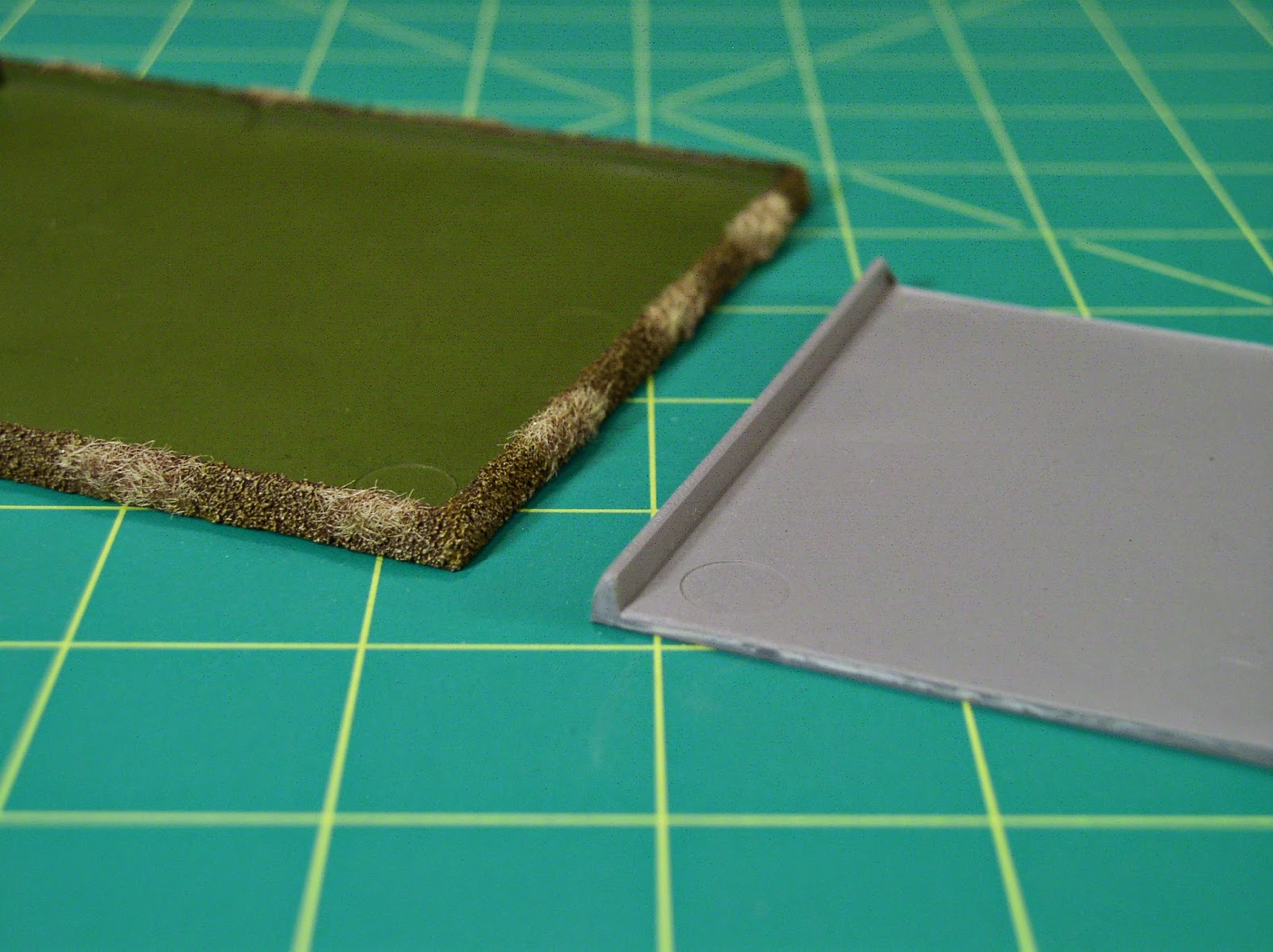
Prime the tray and spray it with a base color. (I use Model Masters Medium Green on my Skaven and Vampire Counts trays so it matches my base edges. As casualties are removed, the exposed green surface also blends into the battlefield a little more.)


Paint the sand and add static grass or flock to match your army's basing scheme, and the tray is finished!


Now the Screaming Bell has a tray large enough to hold the unit pushing it into battle. The tray can also be used to hold any 20mm-based unit in the 10-wide horde formation.


'Til next time!

Older Post ►
 

Copyright 2011 My Unique Hobby is proudly powered by blogger.com